
The business plan, 2000
What the company set out to do, in the words and diagrams of its plan. This page describes the plan; it does not report results.
The company’s first plan, written in summer 1999, had three levels for artists instead of two options: see The first business plan, 1999, with a table of what changed.
The idea
The plan describes ListenSmart.com as “an Internet portal for independent musicians”. Artists would post their music free. Those who chose revenue sharing would make ListenSmart.com their music publisher, song by song, and in return share in the site’s advertising revenue according to how popular their music was, and in the publishing income their songs earned.
The market, as the plan put it: music publishing was “a $6+ billion per year market”; there were “an estimated 67+ million amateur musicians in the U.S. alone, and more than 1 million with recorded content (NAMM 1998)”, but “only an estimated 100,000 artists” had put their music online.
Five profit centers
- Advertising sales
- CD sales, through automated production and consignment
- Artist merchandise sales
- Affiliate link advertising commissions
- Music publishing royalties, “clearly the ‘crown jewel’ of the business model”
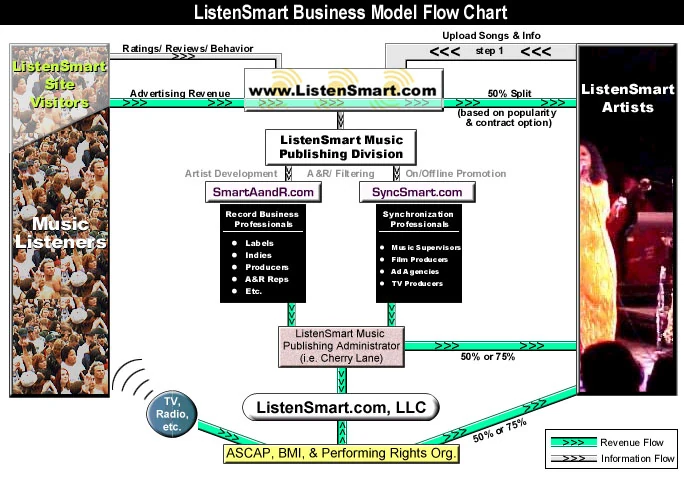
The SmartSuite
The consumer site would feed two business-to-business sister sites. SyncSmart.com would be a searchable database of songs cleared “for movie, TV, film, or commercial synchronization”. SmartAandR.com would give record labels and A&R scouts a “success-factor index” built from the site’s charts.
Two publishing options for artists
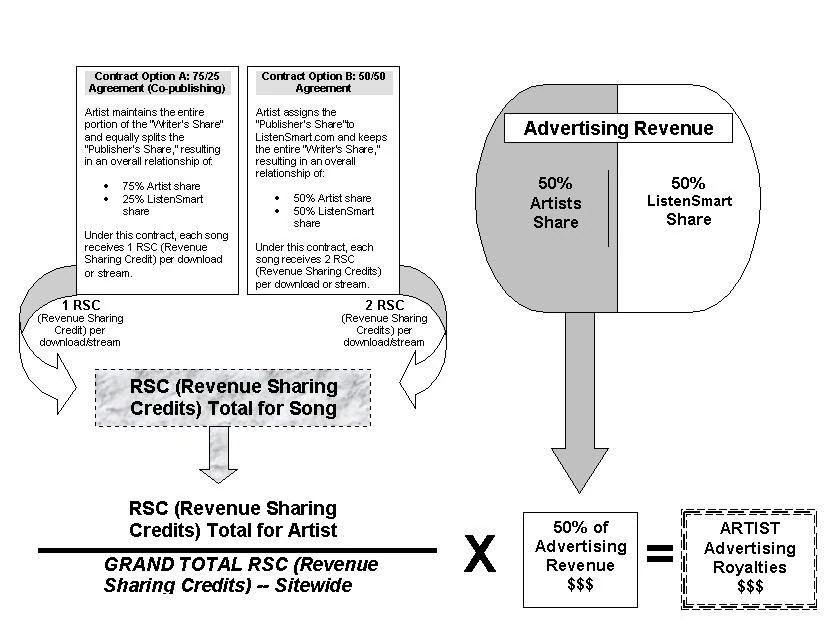
An artist who opted in chose one of two contracts for each song:
- Option A, 75/25 (co-publishing). The artist would keep the full writer’s share and split the publisher’s share: 75% to the artist, 25% to ListenSmart.com. Each download or stream would earn the song 1 revenue sharing credit (RSC).
- Option B, 50/50. The artist would assign the publisher’s share: 50% to each. Each download or stream would earn 2 RSC.
Half of the site’s advertising revenue would go into an artists’ pool, divided by each artist’s share of all credits sitewide.
The reversion clause
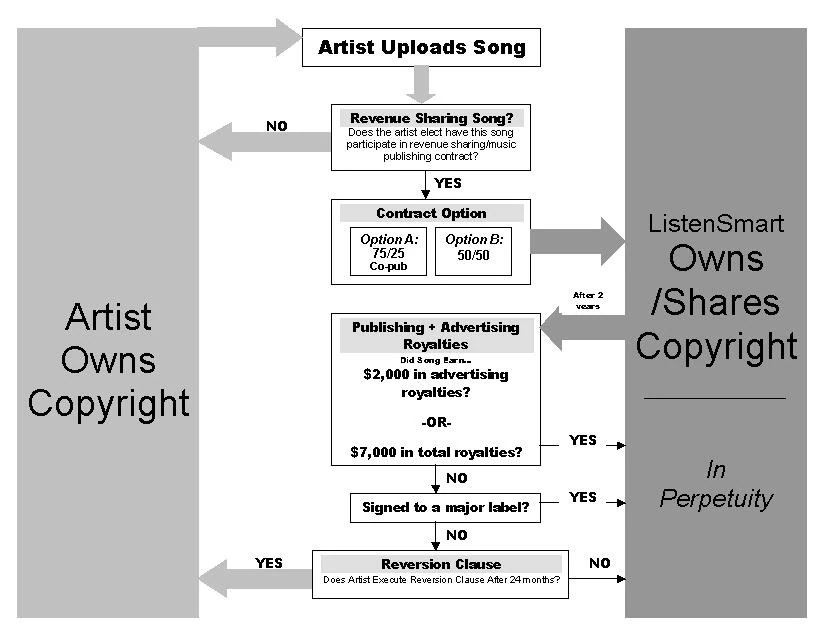
After 24 months an artist could take a song back unless it had earned $2,000 in advertising royalties or $7,000 in total royalties, or the artist had signed with a major label.
The contract as posted, May 2000
Note, 2026: The contracts posted in May 2000 were a beta draft. None was ever signed, so ListenSmart.com never collected or paid any music publishing royalties. Revenue was minimal.
On May 19, 2000, Sean Fenlon posted the beta publishing contracts on the bulletin boards for artists to review, with a primer on music publishing, the business model and an FAQ (“ListenSmart Beta Music Publishing Contracts”), followed by a Q&A on May 25 (“ListenSmart Publishing Q & A, part I”). They add details the plan doesn’t have:
- The company was registered with BMI as “ListenSmart Music Publishing” and with ASCAP as “Always ListenSmart”; SESAC was pending.
- Advertising totals would be audited by an outside accounting firm and posted on an artist-only page. Payouts would be made within six weeks of the end of each quarter, for amounts over $50, and the company promised a guaranteed minimum distribution, to be announced before the official launch.
- Posting on ListenSmart.com stayed non-exclusive; the contract covered publishing only, song by song.
- OmniPost, an optional service, would post artists’ songs to other music sites.
- Artists would get free mechanical licenses for their own CDs, and kept their MP3.com Payback for Playback earnings.
- The ad pool would include all advertising on the site, including five-second rich-media ads at the start of playlists.
- The posted reversion clause: after 24 months the song would return to the artist unless it had been licensed for TV, film or advertising or for release by a major label, or had earned $2,000 in advertising revenue or $7,000 in gross royalties.
- Contracts would be executed only after the beta ended and the site officially launched.
In Sean’s words, 2000
Since I am a musician, I have thought the entire business plan through as an artist.
Bulletin-board post, March 8, 2000
Although we have advertisers lined up and we were prepared to display various banner ads from day one, it was my decision to NOT run the ads until we implemented the whole ad revenue sharing component. I wanted the artists to know that we were NOT earning money on their back while we finishing up our “beta” development.
Bulletin-board post, April 15, 2000
Projections (from the plan)
These are the plan’s forecasts, not results. The company’s 2001 offering memo reported banner advertising as its only revenue, under $10,000 a year.
- Total revenue growing from $1.79 million in year 1 to $43.47 million in year 5, with publishing at $0 in years 1–2, then $3.48 million, $10.49 million and $21.82 million.
- Traffic growing from 4,800 to 125,000 unique visitors a day over 24 months.
- 60,000 registered artists by the end of year 2, 160,000 by year 3 and 300,000 by year 4, half of them choosing revenue sharing.
Funding, as stated in the plan
$500,000 in angel investment from eight private investors at a $5 million pre-money valuation, plus $250,000 in seed capital for the beta launch. The 2001 offering memo puts total funding at $1 million.
Sources: ListenSmart.com business plan, cover dated March 29, 2000 (it also contains material from July 2000); ListenSmart.com offering memo, 2001; bulletin-board posts by Sean Fenlon, March–May 2000; Sean P. Fenlon, 2026 (contracts and revenue). Figure numbers follow the plan’s table of figures.